DefaultPageTemplate.ascx

THE COMPLETE GUIDE TO PICTURE LIGHTING
WHAT ARE THE GOLDEN RULES FOR LIGHTING PICTURES?
1. USE AN EVEN SPREAD OF LIGHT
Keep light balanced across the artwork so there are no bright hotspots or dark corners. Picture lights generally sit centrally above the artwork and angle light back towards the surface.
The greater the distance of the light source from the artwork, the more diffused and wider the spread of light ensuring there is an even spread.
Mixing daylight, warm bulbs, and cool LEDs can distort colours. Try to use one lighting type throughout the scheme.
2. AVOID DIRECT GLARE
Position lights at an angle (often around 30–45°) instead of pointing straight at the picture to create and even wash of light over the picture and avoid bright spots that make it difficult to see the art - especially for glossy surfaces or glass frames.
Overlighting can wash out detail and strain viewers’ eyes. Artwork should feel illuminated, not spotlighted aggressively.
3. CHOOSE BULBS WITH HIGH CRI
Neutral white light (around 3000K–4000K) usually gives the most accurate and pleasing colour reproduction, while lights with a high Colour Rendering Index (CRI 80+) make artwork colours appear true and vibrant.
The CRI indicates how ‘accurate’ a light source is at rendering colours with 100 being perfect. For artwork you need a CRI of 80+.
For everything you need to know about bulbs, read our Guide to Light Bulbs
4. USE SOFT, DIFFUSED LIGHT
Soft light reduces harsh shadows and creates a more natural look for paintings and prints.
Texture can benefit from slight directional shadows, but strong shadows usually distract from the artwork itself.
5. CHOOSE THE RIGHT SIZE LIGHT
The bigger the picture, the more light you’ll need to illuminate it. There are a couple of rules of thumb for getting the size right:
For portrait pictures, choose a picture light that’s about half the width of the picture.
For landscape pictures, choose a picture light that’s between a third and a half of the picture width.
6. HANG ARTWORK AT THE CORRECT HEIGHT.
The centre of a picture should be at eye level, or even lower in a sitting room where most of your time is spent low down on sofas.
For a guide on where to fit wall lights, see our guide: What to Consider for Wall Lights
7. PROTECT THE PICTURE
Avoid fitting your pictures in direct sunlight, in areas of high-heat or UV-heavy lighting that can fade pigments over time. Modern LED bulbs are usually safest.
For wall-mounted art displays, a common professional setup is:
Two lights
Positioned at roughly 45°
Equal distance from the artwork
High-CRI LED bulbs
THE 50-70% RULE:
HOW BRIGHT SHOULD A PICTURE LIGHT BE?
Art galleries follow a 50-70 rule when it comes to lighting paintings and it applies equally to picture lighting at home.
The 50–70 rule refers to the brightness balance between the artwork and the surrounding room. Picture lights are accent lights that should be brighter than ambient lighting, but not overwhelmingly.
Picture lighting should be about 50% to 70% brighter than the ambient room lighting. This makes the artwork stand out naturally without looking harsh or over lit.
For example:
If the room lighting is soft and moderate, the artwork light should be stronger — but not like a spotlight on a stage. Too little contrast makes the artwork disappear into the background and too much contrast creates glare, eye strain, and loss of detail.
For our full range of picture lights, see Picture Lighting
DOES THE PICTURE'S ORIENTATION CHANGE THE SIZE LIGHT YOU NEED?
LANDSCAPE VS PORTRAIT
The orientation of a painting can affect the size, spread, and placement of the picture lights needed to illuminate it. The key factor is not just orientation itself, but the artwork’s width-to-height ratio and how evenly the light spreads across it.
Landscape paintings usually need:
A wider light spread.
Often a longer picture light or multiple light sources for very wide pieces.
Portrait paintings usually need:
More vertical coverage.
Careful positioning to avoid bright tops and dark bottoms.
FOR LANDSCAPE ARTWORK
Wide paintings are harder to light evenly from a single central source because:
The edges can fall into shadow.
Brightness drops toward the sides,.
Hotspots may appear in the middle.
A wider fixture helps distribute light evenly. As a rule of thumb, use a light that isabout 1/3 to 1/2 the artwork width, with a wide beam spread and mounted slightly above the painting’s center line.
FOR PORTRAIT ARTWORK
Tall pieces usually don’t require an especially wide fixture, but beam spread matters more than fixture length.
Portraits sized paintings need:
Enough beam depth to reach the lower section.
Proper distance from the artwork.
Often a slightly higher mounting position.
Otherwise, the top becomes over lit and the bottom appears dim. For portraitsuse a smaller-width fixture with enough vertical beam coverage
WHAT SIZE PICTURE LIGHT DO I NEED?
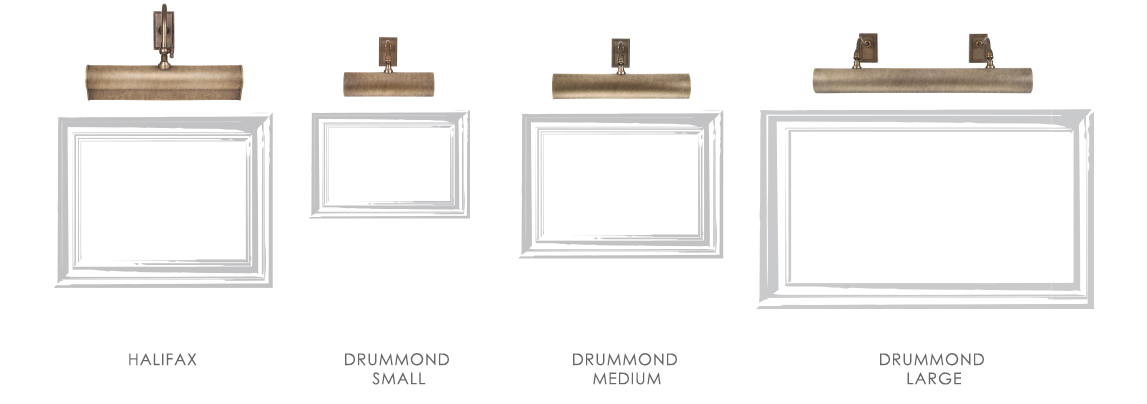
A rule we recommend that for a landscape painting your picture light should be 1/2 to 2/3 the width of the artwork.
For a portrait-sized painting, the picture light should be around half the width of the painting.
Drummond Small – 20cm wide
Suits landscape width 30-40cm, Portrait width 40-45cm
Drummond Medium – 30cm wide
Suits landscape width 45-60cm, Portrait width 60-70cm
Drummond Large – 48cm wide
Suits landscape width 70-100cm, Portrait width 90-110cm
Halifax – 30.5cm wide
Suits landscape width 45-60cm, Portrait width 60-70cm
For our full range of picture lights, see Picture Lighting
WHAT SIZE DO I NEED FOR CANVAS ART?
Frameless canvases and contemporary artworks change how the eye perceives width because there’s no frame to establish a visual boundary.
We recommend staying within the same half-to-two-thirds width ratio while choosing a clean, streamlined fixture that complements the minimal design.
HOW MANY LIGHTS FOR OVERSIZED ART?
Panoramic pieces, oversized landscapes and other unusually wide artworks often need multiple picture lights to prevent the edges falling into shadow.
In these cases, use two or more picture lights spaced evenly across the top of the artwork, or select a single, extra-wide fixture that remains slightly narrower than the frame but scaled proportionately to the piece.
You can also consider using ceiling and track mounted spot lights fitted close enough for the light to was across the artwork, but far enough back for the spots not to be too bright.
HOW HIGH SHOULD A PICTURE LIGHT BE?
Picture lights are generally fitted on the frame or wall above the artwork. The larger the work, the higher the picture light should be positioned to keep the light even and proportional.
As a rule of thumb, the light should be fitted centrally and 15-17.5cm above the picture frame.