DefaultPageTemplate.ascx

Everything you need to know about bulbs
What bulb fitting do I require?
Although there are hundreds of light fittings in existence, most homes only have a few different types the most common of which are shown below. The ‘B’ stands for bayonet and is most commonly used in the UK due to the British Empire, while the ‘E’ stands for Edison Screw - as in Thomas Edison - and is dominant in the USA and Europe.
The ‘cap’ or ‘base’ provides an electrical connection to the light and ensures the bulb is held in the correct position. It is essential to know the cap type to identify the right bulb for you. As a rule, the larger the cap the more wattage and heat it can take and therefore the brighter the bulb.
If you are replacing a bulb, it is a good idea to take it with you, so you know you have the right one. If not, you can use the images below, that show the most common bulb fittings in the UK, as a guide.
Small bayonet fitting (SBC, B15)
Also known as SBC or B15 – push and twist fitting
Width 15mm
Generally used with smaller, lower wattage lights. Most are around 3-4 LED watts, equivalent to a 40W incandescent bulb.
There is not much difference between bayonet and screw fittings other than bayonets have the advantage of not working loose.
Most of our lights are made with lampholders for bayonet bulbs as they are the most common type in the UK. In many cases we can adapt them to take a screw bulb as specified on the product page.
We use small bayonet bulbs as, aesthetically, this allows us to use a narrow candle tube which adds to the elegance of the design. Our candle clip shades are made with a butterfly fitting that can only be used with candle bulbs.
Dimmable – all our small bayonet LED bulbs are dimmable if used with a dimmer switch and product warm white light
Standard Bayonet fitting (BC, B22)
Also known as BC or B22 – push and twist fitting
Width 22mm
A larger twist and push fitting bulb that is designed to take a higher wattage and therefore produce brighter light than small bayonet bulbs.
Our standard bulb is a Classic GLS LED that has a wattage equivalent to a 60 watt incandescent bulb.
Dimmable – all our standard bayonet LED bulbs are dimmable if used with a dimmer switch and produce a warm white light.
Small Edison screw fitting
Also known as SES or E14 – small screw in fitting
Width 14mm
Generally designed for lower wattage lights than larger screw bulbs and most commonly used in Europe and the USA.
Most are around 3-4 LED watts, equivalent to a 40 watt incandescent bulb.
Dimmable – our Small Edison Screw LED bulb is dimmable if used with a dimmer switch and produces a warm white light.
Large Edison Screw fitting
Also known as ES or E27 – larger base
Width 27mm
Generally used for larger lights requiring a brighter light output.
Most commonly used in Europe and the USA, they tend to be around 7-10 watts or equivalent to a 60 watt incandescent bulb.
Dimmable – our Edison Screw LED bulbs are dimmable if used with a dimmer switch and produces a warm white light.

What is a GU10 bulb?
Also known as a spotlight or PAR16 bulb – has two pins with small feet on the end that you push into place.
The GU10 is the most common type of spotlight bulb found in most homes today.
Often used in places where a bright, directional light is needed, such as kitchens and work spaces.
It has the classic spotlight shape, with a narrow base that widens into a flat or slightly rounded aperture. Nnot to be confused with an MR16 bulb that looks identical except for the much smaller, needle-like pins that will not fit a GU10 lamp.
Our GU10 bulbs are dimmable if used with a dimmer switch and produces a warm white light.
What is a G9 bulb?
Miniature bulbs with two small looped pins protruding from the base.
Width 9mm
Traditionally these were mains voltage halogen capsule bulbs that were used in integrated fittings and appliances such as cooker hoods and kitchen cabinet lights.
Now they’ve largely been replaced by LED versions which are longer lasting and more energy efficient.
For more information on our G9 bulbs, see the range here

What type of bulb do I need?
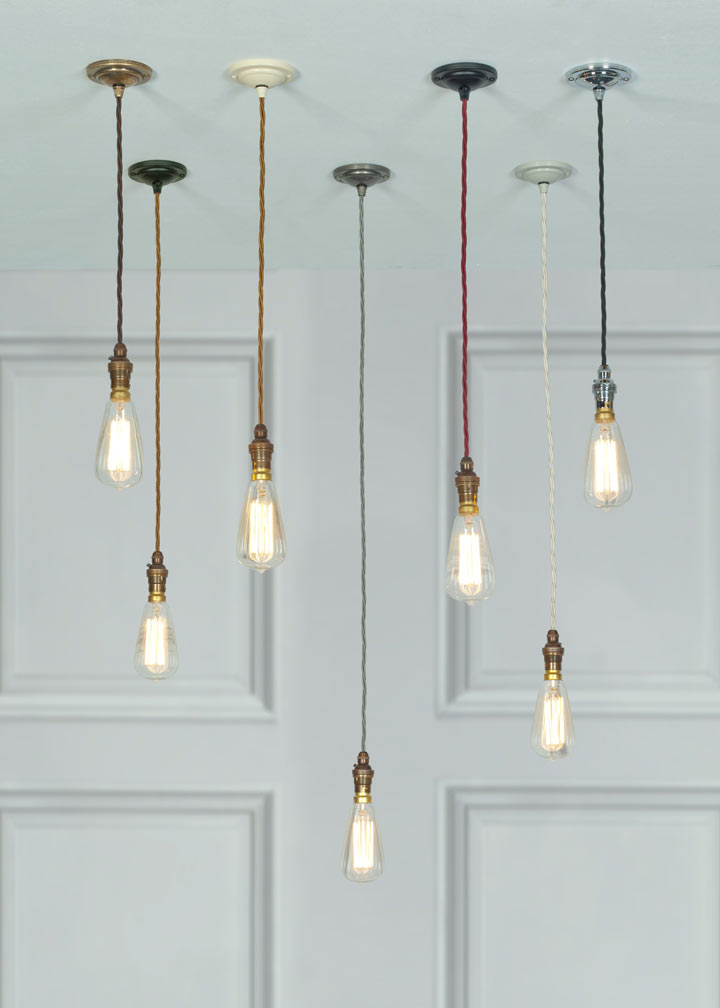
Common bulb types
The bulb’s shape is not just about how pretty it looks but more importantly, about how it throws its light. Most household lights will require bulbs that direct the light everywhere (omnidirectional) but there are some that are designed to give a focussed light such as reflector bulbs, or Gu10 spot bulbs that often used in recessed ceiling lighting.
The two most common bulbs available on the High Street and all good DIY centres are energy saving types - LEDs and Halogen bulbs. CFLs (Compact Fluorescent Lamps) typically found in fluorescent strip lighting have largely been replaced by LEDS.
Although a little more expensive than other bulbs, LEDs are vastly superior in terms of cost efficiency as they as use an astonishing 90% less energy than traditional bulbs, and they last for years.
They also light to full strength immediately and are available in many shapes and sizes and with heritage style filaments that make them better looking alternative to a CFL.
Lastly, halogen bulbs are readily available everywhere. These are closest in colour to traditional bulbs and use 20-30% less energy, but, like incandescent bulbs, don't tend to last long and more significantly, they give off a tremendous amount of heat which can burn fabric lampshades and for this reason we strongly recommend avoiding Halogen bulbs.
All the bulbs we supply are LEDs - to view the collection, see our Light Bulbs category.
LED- Light Emitting Diodes
LEDs have been in common use for over half a century, mainly in electronic equipment, where they’re used as signals and indicators (standby lights, for example) and are now used widely in the home because they are an energy efficient, longer lasting replacement for incandescent light bulbs.
LED bulbs differ from traditional incandescent bulbs in the way they produce light. While old-fashioned incandescent light bulbs passed electricity through a thin wire filament, LEDs produce light through the use of a semi-conductor that emits light energy when an electrical current is passed through it.
LEDs light to full strength straight away, emit the same brightness as traditional bulbs and only use a fraction of the power – around 90% less than traditional light bulbs. They therefore last 10-20 times longer and, unlike energy saving CFLs, can be recycled.
When shopping for LED bulbs, remember the wattage doesn’t denote how bright a bulb. A 5W LED bulb is as bright as a 50W incandescent bulb. The lumens (lm) rating of a light bulb is the best indicator of its brightness.
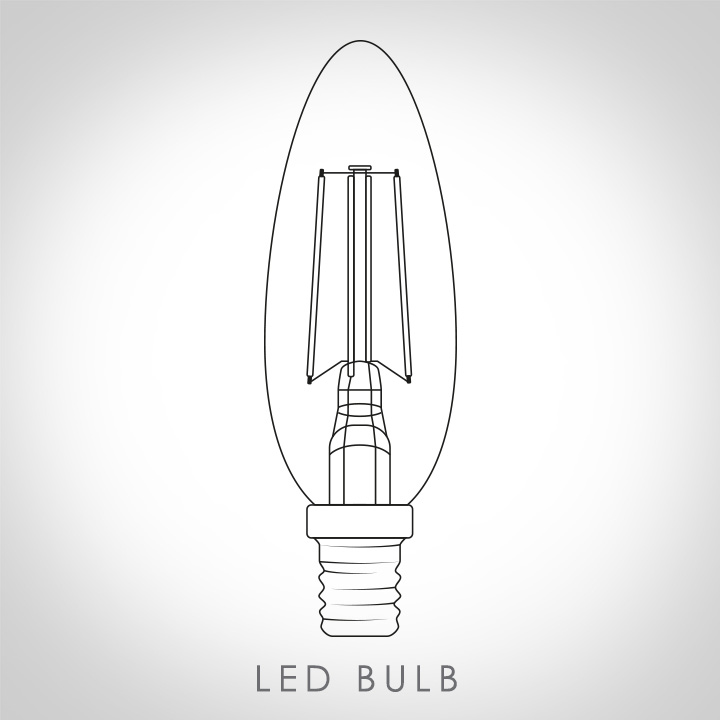
Pros
Energy efficient
Ultra-long lasting – around 25,000 hrs
Lights to full strength immediately
Not hot so safe to use with fabric shades
Works well outside and in low temperatures
Cons
Some LEDs can produce a cooler bluish light.
Most are dimmable but you may need a dimmer switch that recognises low electrical loads
Halogen Bulbs
Halogen light bulbs are the closest you can get to old-style incandescent bulbs in terms of light quality. They score in the high 90s on the CRI scale (Colour Rendering Index) which is a measure of how well a light source accurately reveals various colours. LEDs can’t match this but are still above acceptable levels.
Halogen bulbs have a filament enclosed in halogen gas, so they burn hotter than an incandescent bulb but still use less energy - although they are not as efficient as LED bulbs.
They are commonly used in spotlight bulbs and come in a variety of classic bulb shapes.
We do not recommend using halogen bulbs with our lights as they produce a lot of heat which may scorch the shades, particularly smaller candle shades.
Pros
Closest replacement for incandescent bulb
Cheap to buy
Light to full strength immediately
Are dimmable
Available in all shapes and sizes
Cons
Very hot – might scorch fabric lampshades
Do not last as long as LEDs as the filaments blow

How bright is my bulb?
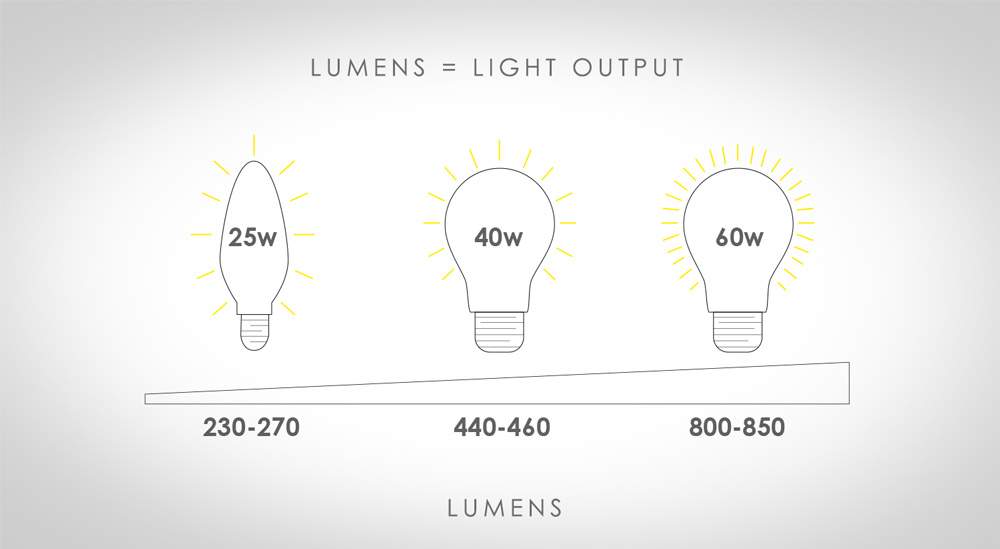
What is Lumens?
Lumens is a measure of how much light you are getting from a bulb.
More lumens means it’s a brighter light; fewer lumens means it’s a dimmer light.
Watts vs Lumens
When shopping for bulbs, remember the wattage doesn’t denote brightness. In the past, when we filled our homes with incandescent bulbs, brightness was measured in watts - which is actually a measure of power i.e. how much energy the light consumes to produce its light.
Since the introduction of energy-saving bulbs, it is a less useful measure of brightness, as new bulbs use a lot less power to produce the same amount of light. So, instead, light output is measured in lumens. The higher the number of lumens, the brighter the light.

HOW WARM SHOULD MY BULB BE?
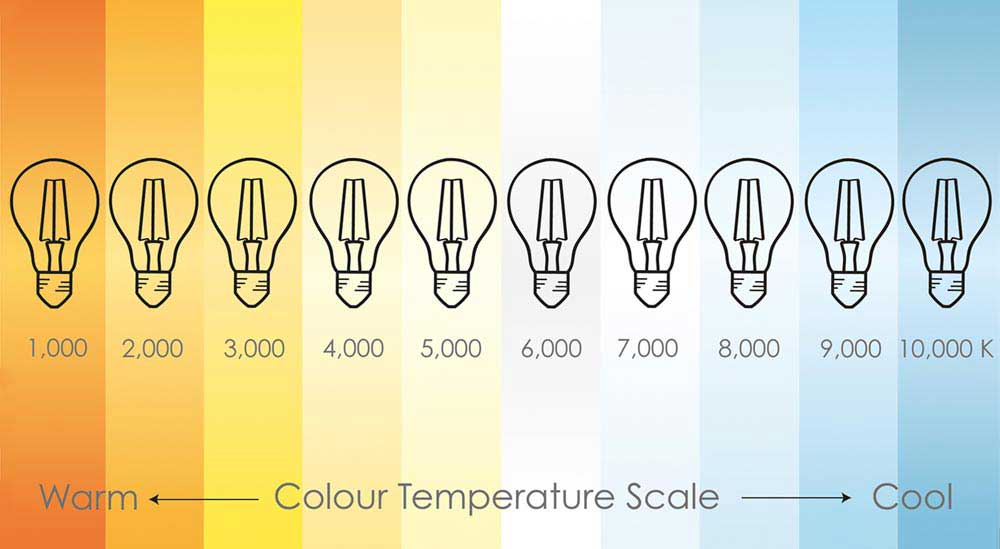
What is Kelvin?
Lumens is a measure of how much light you are getting from a bulb. More lumens means it’s a brighter light; fewer lumens means it’s a dimmer light.
Watts vs Lumens
When shopping for bulbs, remember the wattage doesn’t denote brightness. In the past, when we filled our homes with incandescent bulbs, brightness was measured in watts - which is actually a measure of power i.e. how much energy the light consumes to produce its light.Since the introduction of energy-saving bulbs, it is a less useful measure of brightness, as new bulbs use a lot less power to produce the same amount of light. So, instead, light output is measured in lumens. The higher the number of lumens, the brighter the light.

HOW WELL DOES MY BULB REFLECT COLOUR?
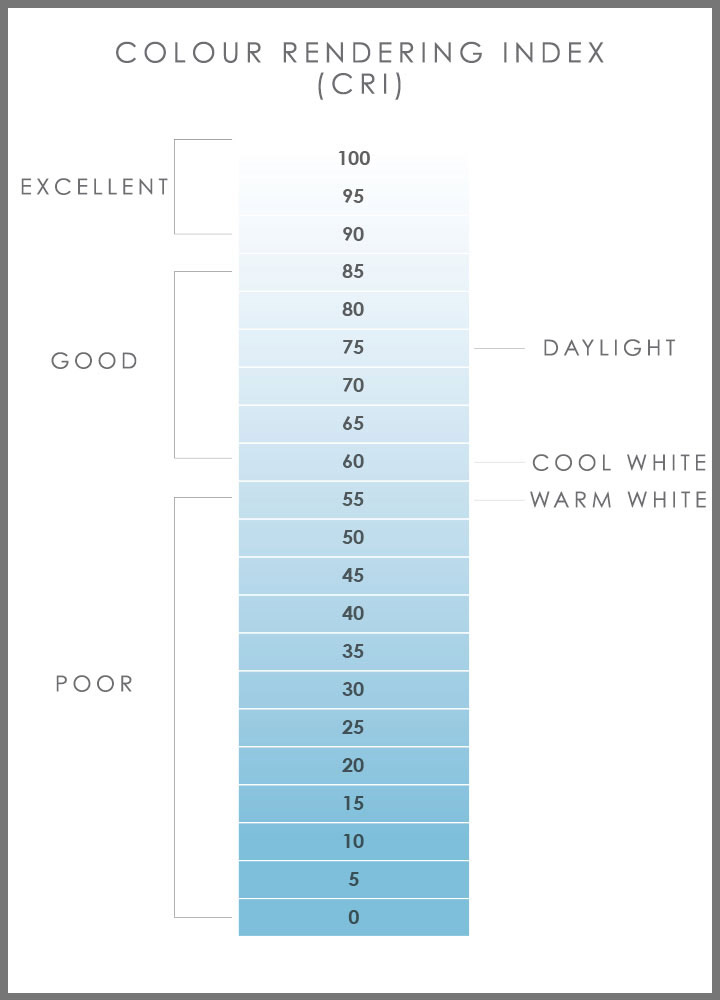
What is CRI or Colour Rendering Index?
The Colour Rendering Index (CRI) is the measurement of how colours looks to the human eye under a light source when compared with sunlight. The index is measured from 0-100 with natural sunlight having a perfect score of 100.
The rating is used by the lighting industry to help discern the colour accuracy of lights. The higher the CRI the better the colour rendering ability. Any light scoring 80-100 means that the colours illuminated by it appear the same, or nearly the same as they would under natural sunlight.
Lights with a CRI of 80 or more are considered to be more than acceptable for most applications. It should be pointed out that CRI has nothing to do with the colour temperature of a light (warm or cold light) as measured by the Kelvin Scale discussed above.
It is possible for lights with the same degree of Kelvin to have completely different CRI ratings, e.g. an incandescent bulb of 2700K (warm) can have a CRI of 100 (equivalent to daylight) while a fluorescent light source at 5000k (daylight) can have a CRI of 75.
Generally, all incandescent and halogen bulbs have a CRI close to 100 meaning they are excellent at rendering colour.
By comparison the CRI of LED and CFL bulbs can vary a lot so always check the packaging for a CRI of 80 or more if you want a true reflection of colour.